
Theoretical Approach on PPP for Universities and Training Institutes in TVET
Downloads
Popular Topics
Downloads
Description
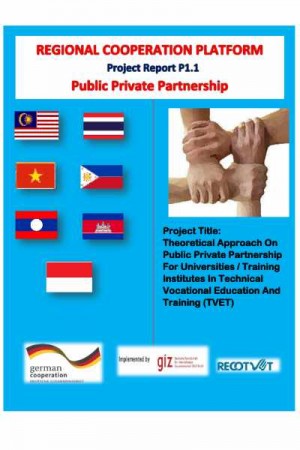
This conceptual framework has been developed to serve as a guide for the Regional Public- Private Partnerships Model development, especially given that it was created based on the national existing practices of PPPs. Also, the framework provides a vision on how to engage the industry, TVET institutions and the government based on the concept of public-private partnerships.
The concept basically aims at ensuring that a student is able to get to know the real work environment and to get an industrial experience, which is the interest of all parties involved in PPP. In fact, over the course of the research, there were no specific policies mentioned with regard to the PPPs implementation which would lead to a successful collaboration with the industry. Even though, the guidelines were developed by the Quality Agency for TVET institutions to ensure that students are able to get the benefit of the training and fulfill the needs of the curriculum, there are still no specific model which would include collaboration among the three major PPPs’ stakeholders comprising the government, the industry and TVET institutions.
Malaysia, Indonesia, Vietnam, Thailand, Lao PDR, Cambodia and the Philippines have considerably contributed to the study by providing their input based on the concept of PPPs implemented in these countries. The purpose of the study is to investigate the PPPs’ models that have been applied within the ASEAN region and at the same time to look into the successful examples of collaborations between the government, the industry and TVET institutions. In this study, six criteria such as accountability, efficiency, relevance, responsiveness, cost-effectiveness and sustainability have been used as performance indicators to investigate the effectiveness of the existing PPP models in the countries participating in the study. Apart from the research and education institutions, other organisations such as the Ministries of Higher Education, the Ministries of Labour, the Ministries of Youth and Sport, the Minitries of Human Resources as well as the Ministries of Rural and Regional Development from different countries have been involved in the research project. The action research project involved participants in theorizing and reflecting on their country’s own Public Private Partnerships’ best practices. In short, the action research can be seen as a form of an enquiry conducted by a certain organization and applied to solve real organizational problems or issues. Therefore, in the context of this study, we are trying to also boost changes with regard to the PPP at the national level as well as contribute to the development of the PPP theoretical concept. In addition, the long-term goal of this research is to encourage the creation of the positive examples of collaborations and a co-inquiry with regard to PPP. As for the methodology, document analysis was used in order to learn about the PPP policies at the national level and their implementation processes. Secondly, the opinions of TVET institution principals, trainers as well as industry representatives and students with regard to PPP were investigated through observation and interviews. Thirdly, a short survey based on the six characteristics such as responsiveness, relevance, cost-effectiveness, efficiency, accountability and sustainability was carried out in order to further explain the performance indicators of PPP. Structural Equation Model has been used as the method of data analysis for this study. As a result of the study, 4 models for PPP were suggested. Most of the models were retrieved from the successful examples of PPPs implementation at the national level. It is also recommended that the government might consider to make an adjustment with regard to the following criteria. For instance, by lowering taxes, providing welfare services and incentives to attract industries for PPP programmes. Previously, education systems were more supply-oriented with an emphasis on the learning process at the institutions. However, the emphasis has to be changed to a demand-driven orientation because current students need to discover real working experiences in the industries so that they skills correspond to the demands of the 21st Century. In fact, this study could serve as a stepping stone to achieve best practices of PPP programmes that will be benefitial for all parties.
Researchers Coordinators
- Universiti Tun HusseinOnn Malaysia (UTHM),
Assoc. Prof. Dr Razali Hassan, Dr Affero Ismail, Dr Mimi Mohaffyza, Dr D’oria Islamiah Rosli, Dr Nor Lisa Sulaiman & Dr Saifullizam Puteh - Rajamangala University of Technology Lanna (RMUTL),
Assoc. Prof. Dr Numyoot Songthanapitak, Niwat Moonpa, Tarapong Karnjanaparichat, Banpot Horbunluekit & Suchin Ingkapradit - Ho Chi Minh City University of Technology and Education (HCMUTE)
Prof. Dr Do Van Dzung
Researchers:
- Ho Chi Minh City University of Technology and Education (HCMUTE), Vietnam , Representative: Assoc. Prof. Dr. Duong Thi Kim Oanh
- Namdinh University of Technology Education (NUTE), Vietnam, Representative: Dr. Phan Sy Nghia, Mrs. Tran Van Khiem,Mr. Nguyen The Manh, Mr. Doan Tuan Nam and Ms. Tran Hong Van.
- University of San Carlos (UOSC), Philippines, Representative: Dr. Jun Javines & Christie Ann Jaca Delfin\The State University of Surabaya (UNESA) , Indonesia, Representative: Prof. Dr. Eko Hariadi, Arie Wardhono & Lilik Anifah
- Indonesia University of Edcation (UPI), Indonesia, Representative: Dr. Agus Setiawan
- National University of Laos (NUOL), Lao PDR, Representative: Prof. Dr. Boualinh Soysouvanh, Dr Bounseng Khammounty, Phannavong Bounphasouk & Soukkaseum Saleumsy
- National Technical Training Institute (NTTI), Cambodia, Representative: Dr. Yok Sothy